
Google DeepMind
@GoogleDeepMind
The engine room of @Google. Building AI safely and responsibly to solve the world’s most complex problems. Join us: https://t.co/jUHQA27iBL
100 postsÚltimo em 23 de out, 11:57Atualiza a cada 15 min
Using a single Nano Banana image and Blender MCP, Gemini 4 Argon built a 3D Gothic cathedral in @Antigravity. It iterates on the geometry, textures, and lighting to create the finished scene.
Not all forests are equal, and now we can map the difference. 🌳 Meet Forest Typology (ForTy): a 10m map of natural, planted, and farmed forests to help identify deforestation and protect the forests that matter most. 🧵
An untouched natural forest holds far more carbon and biodiversity than a single-species timber plantation harvested every decade or two. ForTy sorts every 10x10m patch of land on Earth into distinct forest and tree-crop types ↓
Gemini 4 Argon combined three open-source datasets to build an interactive 3D visualization of human anatomy. Toggle different layers in motion, isolate muscles, or zoom inside a beating heart.
Gemini 4 Argon built a 3D periodic table synced to Tom Lehrer’s song, “The Elements.” Created in @Antigravity, it animates orbiting electrons, atomic data, and light spectra.
Four Gemini 4 Argon agents beat Minecraft from scratch in 27 hours. Operating in a sandbox using only code and text, they wrote 2,783 programs, divided up jobs over chat, shared notes, and debugged errors together - all with no human help ↓
 Maxence Faldor@maxencefaldor
Four Gemini 4 Argon agents, one shared Minecraft world, one goal: defeat the Ender Dragon. 27 hours and 2,783 self-written programs later, the dragon fell. x.com/i/article/2111…
Together with scientists around the world, our models and tools are helping make disease more detectable, treatable, and preventable. 🧬 From pinpointing rare genetic variants to speeding up drug discovery, here’s how we’re helping turn lab breakthroughs into real-world care → t.co/sM5G0CLcKJ
SynthID has been named one of @TIME's Best Inventions of 2026. With over 180 billion images and videos already watermarked, it’s making it easier for people to distinguish AI-generated content from other media → goo.gle/4jsZxWF
Gemini 4 Argon is already unlocking new scientific breakthroughs in quantum computing, nuclear fusion, protein design and beyond. 🧵
Argon is helping accelerate progress across both quantum error correction and algorithm design. 🧮
 Ben Jaderberg@benjaderberg
First, we used Argon to translate an internal version of our quantum error correction decoder, AlphaQubit, into a single, highly optimized hardware “megakernel,” nearly doubling inference throughput.
Over half of reported crimes in Singapore use sophisticated social engineering. With @GovTechSG, we’re building on-device fraud detection using our open model Gemma. By fine-tuning it on local scam tactics, it identifies threats in real time without compromising personal privacy → t.co/VdCio2nrHC
Gemini 4 Argon taught a robot to play cornhole just by watching a video. It mapped the physics, coded its own simulation, and taught @Apptronik's Apollo humanoid to sink 7 throws in a row.
By turning video into a training ground for physical AI, Argon compresses weeks of manual modeling into just a few hours. ↓ goo.gle/3W85sXj
@Apptronik By turning video into a training ground for physical AI, Argon compresses weeks of manual modeling into just a few hours. ↓ goo.gle/3VxIB7v
Gemini 4 Argon is now globally available. Built to solve your hardest problems from start to finish, the model brings frontier capabilities across coding, enterprise workflows, and cyber defense.
Here’s how you can try it: 🔵 Everyday users: In the @GeminiApp and AI Mode in Search for Google AI Pro and Ultra subscribers. 🔵 Developers: Gemini API paid tier, plus @Antigravity and @GoogleAIStudio for Google AI Ultra subscribers. 🔵 Scientists: Apply for the top usage tier in @Antigravity free of charge. 🔵 Enterprises: Gemini for business and in Antigravity. Find out more → t.co/6nH9sCdObL
SynthID Detector is now available to everyone. 🌐 Check whether online content was generated using @GoogleAI, or with tools from our industry partners – including @OpenAI, @NVIDIA, Kakao and coming soon, @Apple. Try it out → synthid.com
SynthID Detector can quickly identify our watermarks in video, audio and images – even after edits, like adding filters. ✂️ You can also use existing AI identification features found in @GoogleChrome, @Google Search, and the @GeminiApp.
Meet EmbeddingGemma 2, our first natively multimodal open model for on-device embeddings. It expands beyond text to unify code, images, audio, and video in a shared space. 🧵
At 740M parameters, it’s competitive across benchmarks – even outperforming some specialist models more than twice its size. Developers can use it to add multimodal search to their apps – like finding moments in a video using a voice memo – or pair it with Gemma 4 for private, on-device RAG. EmbeddingGemma 2 is released under an Apache 2.0 license. Check out the weights on @HuggingFace and @Kaggle. Find out more → t.co/lRsjbvR5VB
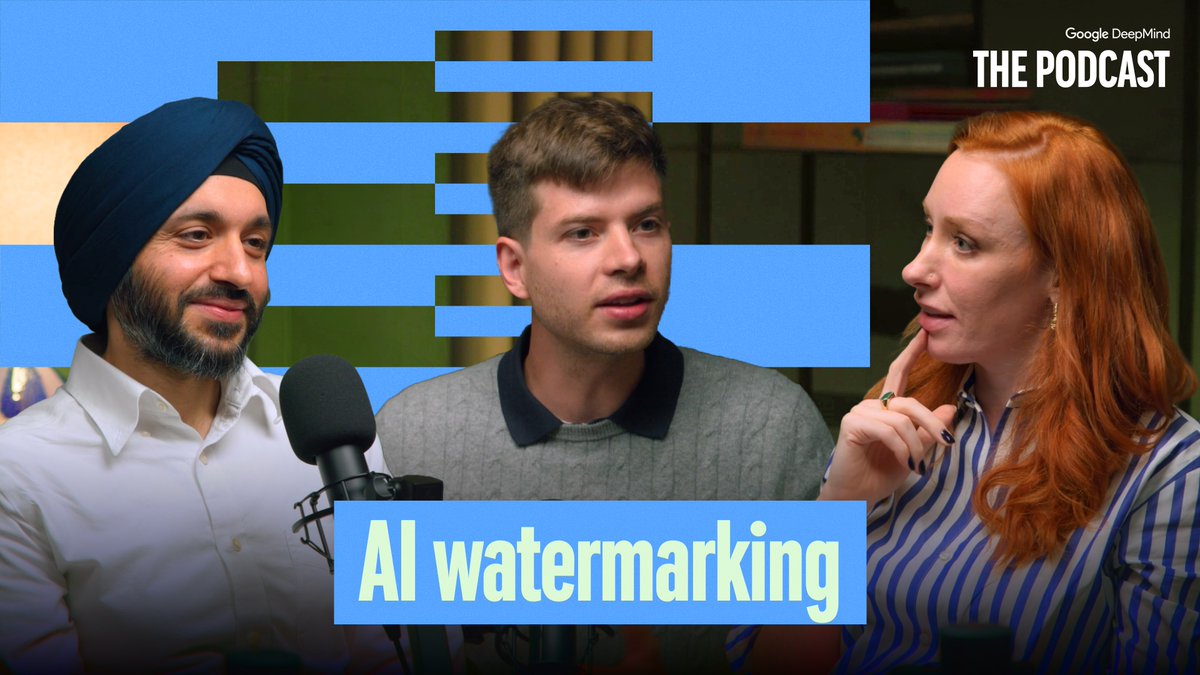
When AI-generated content has become so realistic, how do we verify what's made by human, machine, or nature? We explore the vital role of provenance – and how imperceptible watermarking can safeguard both digital media and biological designs – on our podcast. ↓ Timecodes: 00:00 Introduction 00:34 What is a watermark? 04:35 SynthID 15:16 Images and video 19:28 SynthID Bio 28:00 Future of resilience
Watch → goo.gle/4de3fiR Spotify → goo.gle/4dKZwte Apple Podcasts → goo.gle/4dQqKyH Or listen wherever you get your podcasts! 🎧
SynthID Bio is our new family of watermarking methods made for AI-generated biological designs. In a world first, we can now embed an imperceptible signature directly into protein sequences without affecting their biological function. 🧵
Acting like a digital ID card, the watermark can help DNA labs verify synthetic proteins and keep sequence databases accurate. As these requests increasingly scale, verifying if designs come from AI with built-in safeguards will help labs automate and strengthen biosecurity. 🛡️
Introducing Gemini 4 Argon – our new frontier model. It’s built for complex workflows across coding, enterprise knowledge work, and cybersecurity defense – rolling out today to a set of trusted testers through our Fairwind Program.
With a 1M token output limit, Argon adds a deeper level of reasoning to tackle long, multi-step problems in one go. Feedback from early testers will help us strengthen our systems before we roll out more broadly to developers, enterprises, and consumers soon. Find out more → t.co/ME8aonkOOj
Create and deploy custom audio with our new text-to-speech models: 🔵 Gemini 3.8 Flash TTS: Design unique voices with distinct accents and characteristics. 🔵 Gemini 3.8 Flash-Lite TTS: Built for efficiency and scale, choose from your created styles or our expansive production-ready library.
Fine-tune the delivery line by line, shaping pacing, emotion, and cues like laughs or pauses. All generated audio is watermarked with SynthID so it can be reliably identified as AI-generated. Start building with the Gemini API via @GoogleAIStudio. Find out more → t.co/F93tMO9Fxt
Researchers at @BroadInstitute, @UniofExeter, and beyond are already using AlphaGenome Atlas to better identify potential disease-causing DNA variants and interpret their role. 🧵
Scientists at @BroadInstitute search for the underlying causes of unexplained rare disease cases, but the list of possible mutations is vast. Using Atlas, researchers pinpointed a critical mutation in the DNM1 gene, which was confirmed and validated in the lab.
We’re introducing Gemini 3.8 Live and 3.8 Live Extended Thinking – our best conversational AI. The models talk, think, and handle tasks in the background without breaking your flow. 🧵
Watch how we used 3.8 Live Extended Thinking to act as a programming tutor. Both models feature: 🔵 Upgraded reasoning 🔵 Near real-time visual understanding 🔵 Automatic detection for 97 languages 🔵 Background tool calling without disrupting your chat For your most difficult tasks, 3.8 Live Extended Thinking adds increased performance and precision – narrating task progress to keep the conversation going. Try it now in Gemini Live in the @GeminiApp or start building with the Gemini API via @GoogleAIStudio. Find out more → t.co/b0vG4bO6fK
Weather forecasts play a critical role in the transition to renewables. WeatherNext 3 provides grid operators as well as wind and solar power producers with predictions for turbine-height wind speeds and solar radiation, enabling smarter, cleaner energy planning. 🧵
Because conditions can shift quickly, WeatherNext 3 updates every single hour: 💨 For wind farms: Predicts speed and direction at turbines as high as 100m to project power generation. ☀️ For solar farms: Forecasts cloud cover and radiation to estimate sunlight levels reaching solar panels.
How can we reconstruct a memory that was never filmed? Our team paired restored archival photos with pose control models to capture the mannerisms and micro-expressions of Burt and Ethelle. This helped bring the day they first met to life for Love, Rendered, a new documentary in collaboration with @PrimordialSoup_ and @StorySyndicate_. Watch the full film on YouTube → t.co/x4R6lBIl9j
From tracking hurricanes to optimizing renewable energy grids, @PeterWBattaglia and @fryrsquared explore how WeatherNext 3 is shaping how we model forecasts and prepare in a fast-changing climate. Podcast timecodes: 00:00 Introduction 00:38 Hurricane Melissa 11:50 Why weather forecasting is hard 14:13 Traditional models vs AI models 21:55 Probabilistic forecasting 26:00 WeatherNext 3 33:00 Future outlook 43:44 Hannah's reflections
Watch → goo.gle/4ykjgvy Spotify → goo.gle/4gUkw1w Apple Podcasts → goo.gle/4xNeneE Or listen wherever you get your podcasts! 🎧
We’re launching AlphaGenome Atlas: an AI-powered searchable database mapping the predicted impact of all 9 billion possible single-letter DNA changes. Here’s how it could help researchers better understand our biology 🧵
AlphaGenome Atlas is over 30 times larger than the AlphaFold Database. It gives scientists an intuitive way to explore this vast 1-petabyte dataset - unifying interconnected resources so researchers can link genetic variants directly to the molecular mechanisms they disrupt.
WeatherNext 3 is a major breakthrough in how we forecast global weather. ⛅ Developed with @GoogleResearch, the model learns directly from real-world, real-time observations to give more localized highly accurate predictions faster. 🧵
While traditional compute constraints limit standard weather updates to six-hour intervals, WeatherNext 3 ingests real-time satellite data directly to launch a brand-new forecast every single hour.
Gemini 3.8 Flash Cyber gives defenders a decisive advantage with expert vulnerability detection and autonomous patching. Here’s how it helps teams stay ahead of emerging threats 🧵
Security teams often face a tough trade-off: large frontier models can be expensive and slow to use, while smaller options struggle with complex code repair. 3.8 Flash Cyber generates secure, deployable fixes in minutes – all within an organization's cloud environment.
Two new Gemini models are here to help scale your AI agents and secure code: 🔘 3.8 Flash: our most intelligent model yet with significant gains from 3.7 Flash across software engineering, agentic tasks, and multi-step reasoning. 🔘 3.8 Flash Cyber: our most capable cybersecurity model with frontier-level vulnerability detection and automated patching.
Our new Fairwind Program helps governments and trusted partners stay ahead of threats – giving access to 3.8 Flash Cyber to secure vital infrastructure and protect national security. Gemini 3.8 Flash is rolling out now in @Antigravity and via the API in @GoogleAIStudio and @AndroidStudio. Google AI Pro and Ultra subscribers can access 3.8 Flash in the @GeminiApp and AI Mode in @Google Search. Find out more → t.co/W3GGo74GKX
We’re bringing agentic video understanding to our latest Gemini models. They can now analyze videos with better accuracy while using up to 88% fewer tokens. 🧵
Instead of scanning an entire file, Gemini reasons across the video’s transcript, audio, and frames, dynamically adjusting the frame rate to pull the exact moments needed. The efficiency gains are most significant for long-form content, from 10-minute guides to multi-hour recordings. Agentic video understanding is rolling out to 3.7 Flash, 3.6 Flash, and 3.5 Flash-Lite via API in @GoogleAIStudio and coming soon in the @GeminiApp. Find out more → t.co/bjPn5V52zr
We’re rolling out Gemini Omni 1.1 Flash to make generative video highly controllable, faster to iterate on, and more polished for production-grade use. Here’s how you can try it in @FlowbyGoogle and more → t.co/nV8brVS9xR
From weather forecasting to robotics, intelligent decision-making relies on understanding the unknown. Our VP Research @ZoubinGhahrama1 explores with @fryrsquared why teaching systems self-doubt and probability can lead to safer, more reliable real-world decision-making. 🧠 Watch the episode ↓ Timecodes: 00:00 Introduction 01:06 The role of uncertainty 07:45 Correctness vs confidence 09:40 Historical perspectives 16:10 Bayesian thinking in AI 26:30 Uncertainty in the real world 36:42 Future research and AGI
Watch → goo.gle/4cZu4qH Spotify → goo.gle/4cOy1hZ Apple Podcasts → goo.gle/3UmoBE5 Or listen wherever you get your podcasts! 🎧
In an industry first, we’re piloting double-blind evaluations for frontier AI. By creating a secure environment where neither test prompts nor model weights are revealed, we can ensure external safety and performance evaluations of our models remain private, robust, and trustworthy. → t.co/ocwQ2iWFDz
Gemini 3.5 Transcribe is our latest speech-to-text model for precise and intelligent transcriptions. 🧵
Here’s what’s new: 🔵 It’s better at understanding complex phone numbers, postal codes, and order IDs – even in noisy environments. 🔵 It can remove filler words and auto-format your text. 🔵 It recognizes custom vocabulary so the model knows unique names and product titles. 🔵 It automatically detects and transcribes speech in 85+ languages. Try it now in the @Geminiapp on macOS and Gboard on @Android. Start building in @GoogleAIStudio and @Antigravity → t.co/lNlILGYFVy
Games have been an important testbed for our AI research for over 15 years. 🎮 From mastering Atari to reaching Grandmaster in StarCraft II, they have driven some of our biggest AI breakthroughs. Our work with SIMA taught agents how to understand 3D worlds, but learning to navigate real human dynamics takes a living, persistent universe. Through our research partnership with @FenrisCreations, we’re exploring how to tackle open challenges in AI: 🔵 Continual learning to acquire new skills without forgetting past knowledge. 🔵 Deep memory systems that store and retrieve information far beyond today’s context windows. 🔵 Long-horizon planning over weeks, months, or years. 🔵 Multi-agent dynamics spanning cooperation, negotiation, economics, and emergent behaviors. Our long-term goal is to use AI to discover entirely new gameplay experiences in partnership with game developers – making games more accessible and personalized – while applying what we've learned to problems in the real world and scientific discovery. Find out more → t.co/fAbYdukA5A
Gemini 3.7 Flash is here. It’s stronger for coding, knowledge work, and web development. 🧵
🔵 It shows strong gains over 3.6 Flash in key coding tasks like debugging and issue resolution. 🔵 It’s better at designing more functional web layouts and apps using fewer prompts. 🔵 It delivers improved reasoning and accuracy when completing real-world business workflows. Try it now in @Antigravity, with API access in @GoogleAIStudio and @AndroidStudio. Google AI Pro and Ultra subscribers can use 3.7 Flash in Gemini Spark in the @GeminiApp. Find out more → t.co/talohYpXqK
SL2T is our breakthrough sign language-to-text model powering new features for Deaf and hard of hearing users on @Android. Starting with American Sign Language-to-English on Pixel 11, people can sign directly into Gboard and Live Transcribe instead of typing.
For years, building AI for sign language has been slow due to complex technical challenges and misconceptions about how the languages work. We addressed this by training a model to translate simultaneous movements of the hands, body, and face directly into text, using huge amounts of data.
We sat down with Apollo 2 to talk about what it's really like running on Gemini Robotics 2. 🤖
FInd out more → goo.gle/3Tvi61l
FInd out more → goo.gle/3Tvi61l
Predicting cyclones accurately can help save lives - and every hour of lead time counts. Published in @Nature, our AI model WeatherNext achieves state-of-the-art accuracy in forecasting a storm’s track and intensity, giving us a critical extra 24 hours to prepare on average. 🧵
WeatherNext delivers a decade's worth of forecasting progress in a single leap. 📈 On average, 3-day predictions now match the quality that prior models could only provide 2 days out.
This is how Gemini Robotics 2 helps @Apptronik’s Apollo 2 use whole body intelligence to pack for a sports game ↓
To be truly useful, a robot needs the dexterity that humans take for granted. But asking AI models to coordinate these motions is incredibly complicated. In this demo, we pushed Apollo 2 to master fine motor skills and complete tricky kitchen chores ↓
One brain. For any robot. 🤖 We’re launching Gemini Robotics 2: our next-generation physical AI bringing full body intelligence to humanoids, advanced dexterity, multi-robot teamwork and more.
Three new models power this breakthrough: 1️⃣ Gemini Robotics 2: A vision-language-action model controlling humanoids from feet to fingertips 2️⃣ Gemini Robotics ER 2: Capable of real-world video understanding and complex, multi-step planning 3️⃣ On-Device 2: Runs locally and adapts to new robot bodies in just a few hours
Gemini 3.5 Flash Cyber is our specialized, lightweight model built to help security teams spot and patch vulnerabilities before they can be exploited. 🧵
By combining speed and efficiency, 3.5 Flash Cyber lets defense specialists check significantly more code paths. In testing on our own codebases – including @googlechrome and @Android – it consistently caught complex, unique vulnerabilities that standard models missed.
We’re expanding our work with the US Dept. of @ENERGY on the Genesis Mission – an initiative to double the pace of scientific discovery within a decade. 🧪 By committing $40M in AI tokens and @GoogleCloud credits, more lab researchers will gain access to Gemini and other AI models. → t.co/FBA5iCtTED
Gemini 3.5 Flash-Lite is our fast, cost-effective model for scaling repetitive use cases like sorting tickets and extracting data. Watch how it performs against 3.5 Flash on a series of high volume tasks ↓
It even outperforms 3 Flash on many agentic and coding benchmarks. 3.5 Flash-Lite is rolling out in the @GeminiApp and @Google Search, with API access in @GoogleAIStudio and @AndroidStudio. Find out more → goo.gle/4yyNkoi