Here to help.
This week, we’re celebrating World Space Week with a series of Google Doodles spotlighting stunning views of the universe, honoring the technology and human ingenuity that make space exploration possible. 🚀🌌Happy Space Week! #GoogleDoodle
Here’s how to get the lowest possible price on your holiday flights, according to five years of aggregated Google Flights data. 👇 ✈️ Connecting flights can also be a big money saver. Nonstop tickets are 20% more expensive on average. ✈️ When you travel is key for saving: Departing on a Monday and returning on a Tuesday or Wednesday saves about 14% over weekend flights (and up to 20% domestically versus Sunday). ✈️ Wednesday beat Tuesday as the absolute cheapest day to book a flight, but the difference is negligible — buying a ticket on a Wednesday only saves you about 1.4% compared to Sunday, the most expensive day.
Get a full breakdown of this year’s top trending destinations and more helpful holiday travel tips. goo.gle/4zmpknS
Our medical research system, AMIE, is the first patient-facing conversational diagnostic tool of its kind to be studied prospectively in a real-world clinical setting. In a study, published today in @TheLancet, we found that when patients chatted with AMIE before an in-person appointment, the interaction built their confidence and helped them organize their thoughts. And physicians who reviewed the information from the patient conversation got more time back to focus on collaborative care and shared decision-making instead of digging through data.
Conducted in partnership with @BIDMC_Medicine, the study demonstrates technology’s potential to strengthen the relationship between doctors and patients. Learn more ↓ goo.gle/3VCGhMl
Around two thirds of people around the world lack access to diagnostic health tools, like ultrasounds. We’re working to change that. Here’s how ⬇️
In our prospective clinical study, our models were able to pinpoint the gestational age within 4 days of accuracy which is a tight enough zone that can have a really meaningful clinical impact. If we're able to expand these tools to low resource settings, we can start to move the needle on maternal deaths and bridge that gap in care that we see all over the world.
What are people craving around the world? Our first-ever @GoogleMaps Fan-Favorite Dining List taps into Maps reviews, ratings, and searches for directions to analyze the biggest dining trends and popular restaurants across 10 global food hot spots: Atlanta, Chicago, London, Melbourne, Montréal, New York, San Francisco, Santiago, Seattle, and Tokyo.
From trending flavors to reviewer go-tos that won’t break the bank, here’s a taste of what topped the list this year ↓ goo.gle/4AWK3Aa
Project Suncatcher is our moonshot exploring whether we can one day host machine learning infrastructure in space 🚀 To do so, we need to know whether our AI hardware can operate in orbit. Can our TPUs handle the physical stress of spaceflight and the radiation and thermal extremes of space? These are the questions Google researchers have been exploring for the past few years. Last week, we launched our first test satellite carrying four TPUs into orbit — putting us one step closer to getting answers.
Some things can only be tested in space — like how the hardware holds up to solar events, cosmic rays, or bitflip errors caused by radiation — which is why we’re putting our first TPUs in orbit.
Today, we're expanding SynthID Detector in partnership with @OpenAI, @NVIDIA, Kakao & soon @Apple as part of an industry-wide effort to make AI-generated content more transparent. Available globally in English, our verification portal lets you check if media was made with AI 🧵
Want to check if an image, video, or audio file was made using AI? Here’s how: 1️⃣ Go to synthid.com and upload an image, video, or audio file 2️⃣ The portal scans the media to detect if the file contains a SynthID watermark from Google or our partners
Forecasting where a disease outbreak might spread usually requires weeks of stitching together fragmented satellite imagery, census tables, and local health records. Now, new research shows how Google Earth AI can help communities address public health crises more quickly and proactively. By combining insights beyond simple statistics — like behavioral trends, geospatial AI models, and more — public health teams can better understand complex public health issues, bridge reporting gaps, and shift emergency response from reactive management to proactive prevention.
Google Earth AI can bridge critical gaps across diverse geographies, diseases, and areas of public health using autonomous predictions and population dynamics. The system combines environmental signals and other data sources with AlphaEarth Foundations and our Population Dynamics Foundation Model (PDFM), and a prototype Geospatial Reasoning agent. In plain language, researchers ask questions like where a disease is likely to spread next, and the AI automatically gathers relevant models and datasets to build an accurate prediction model. By combining satellite views with population patterns, the tool reveals hidden risk factors, helping identify issues earlier.
We’re releasing EmbeddingGemma 2, our first natively multimodal open model engineered for on-device embeddings. Built on the Gemma 4 architecture and released under an Apache 2.0 license, it goes beyond text to unify images, video, audio, and code in a single embedding space.
EmbeddingGemma 2 is optimized to run locally on mobile and desktop. This means you can find a specific video clip from a voice memo, or search through hours of audio with a simple text query, all without an internet connection.
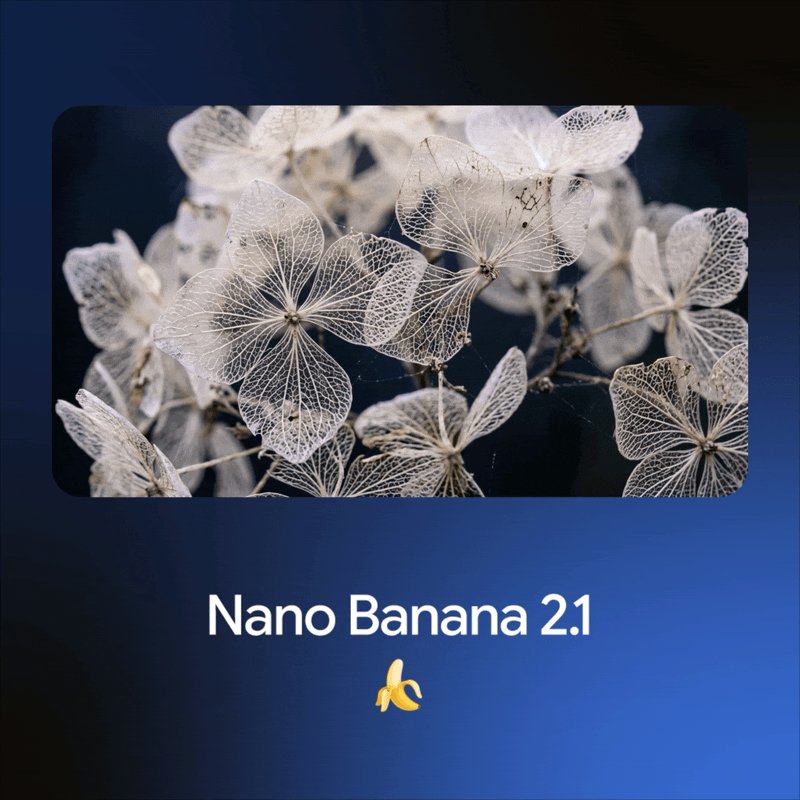
Meet Nano Banana 2.1, our latest image generation and editing model 🍌 This upgraded version outperforms our previous models across the board, with notable leaps in visual design, mask-based editing, and subject consistency to help you create more natural-looking images.
Nano Banana 2.1 starts rolling out today across @GeminiApp, AI Mode in Search, @GoogleAIStudio, @FlowByGoogle, @StitchByGoogle, Google Ads, and Gemini Enterprise Platform.
👇 Here’s your recap of our biggest AI updates from September 👇
Catch up on more of our AI news from last month. goo.gle/4jzgTkq
Up, up, and away. 🚀 Today, in partnership with @planet, we launched a prototype satellite carrying four TPUs into orbit on @SpaceX's Transporter-18 rideshare mission. This launch is the first step of Project Suncatcher, our long-term research moonshot to see whether we can one day host scalable machine learning infrastructure in space. Over the coming weeks, we'll gather in-orbit data on how our TPUs handle the physical stress, radiation, and thermal extremes of space. Whatever we learn, we'll use it to refine our future designs.
Learn more. goo.gle/4hcNNWK
Today we’re introducing Gemini 4 Argon. It delivers frontier performance in complex workflows across real-world software engineering, knowledge work, and cybersecurity defense with an industry-leading 1M token output limit.
Gemini 4 Argon is our next era of frontier intelligence. It shows significant improvements across benchmarks, setting a new state of the art for real-world long-horizon software engineering tasks.
We're introducing skills in @GeminiApp to help you automate your most repetitive tasks. Now, you can now save your most-used instructions once and run them endlessly by typing a '/' in the prompt bar.
Skills are already available in Gemini Spark, and they will soon replace Gems to make building custom shortcuts even easier. But don’t worry — we’ll automatically migrate your Gems into skills when Gems go away. And over the coming weeks, skills will have the same features you loved in Gems, including the ability to share them with others and add Google Drive files. Learn more ↓ t.co/9OdnNCdXIp
.@googlearts has partnered with 3,000+ cultural institutions across 90+ countries to make art and heritage accessible to everyone—and today, we’re rolling out a refreshed mobile app experience. 📱🌎 Here are some of the new ways you can use it to explore world culture 🧵↓
1️⃣ An all new homepage From cultural moments to interactive modules, the updated homepage updates daily with new experiences across the app to inspire your daily discovery and showcase the world's culture.
Gemini 3.8 Flash TTS turns voice generation into your full creative studio. Design original character voices from scratch across 100+ languages, stage two-speaker dialogue, and tailor every performance line by line with natural laughs, sighs, whispers, and more.
Learn more about Gemini 3.8 Flash TTS ↓ goo.gle/3V5NpRb
This week, we released two new audio models for creative production and cost-efficient speech at scale. Hear what's possible with Gemini 3.8 Flash TTS and Gemini 3.8 Flash-Lite TTS 🧵
Create voices from scratch across 100+ languages and dialects using natural language prompting. Customize role, accent and voice characteristics with prompts like “subtle Southern US accent” or “soften the delivery”.
For the first time, a group of researchers — including scientists from @GoogleResearch and HHMI Janelia — built the first complete brain map for a male fruit fly. Together, we mapped every single neural connection in a male fruit fly brain and central nervous system, amounting to more than 166,000 neurons. Here’s why we did it.
Learn more: goo.gle/4hMDadh/
After years of research, Project Suncatcher is scheduled to embark on its first test in orbit, launching a prototype satellite to evaluate how Google Tensor Processing Units (TPUs) perform in space. Learn more about the science behind this moonshot. ⬇️ x.com/i/article/2103…
We’re sending TPUs to space (yes, really). After years of research, we’re launching a satellite to evaluate if and how Google Tensor Processing Units (TPUs) hold up in orbit. The test mission, as part of our latest moonshot — Project Suncatcher — is designed to gather data exploring how we can one day host machine learning infrastructure in space.
We partnered with @planet to send a prototype satellite carrying four TPUs into orbit. We’ll be looking to see how well the TPUs withstand the harsh conditions of space to assess whether we can eventually host machine learning in orbit.
Introducing three new @googlechrome features designed to help students manage their workloads, prep for tests, and make the most of their semester.🧵
🔎 Dive deep on topics We’re expanding Gemini in Chrome so it can identify key takeaways, find specific information, or clarify confusing moments on almost any audio or video file once you’ve played it through.
Packed photo library? Make the most of your memories with these 5 @GooglePhotos updates 🧵
1️⃣ Select, brighten, and share your favorite photos with a single text prompt using Photos in Gemini Spark
Can you hear that? Our Gemini Audio family is getting louder 🔊 We're introducing two of our most expressive audio generation models yet from @GoogleDeepMind: Gemini 3.8 Flash TTS and Gemini 3.8 Flash-Lite TTS.
Gemini 3.8 Flash TTS and Gemini 3.8 Flash-Lite TTS turn voice generation into a dynamic creative studio. 🎙️ Design bespoke voices from scratch across 100+ languages using simple prompts 🎬 Tailor scenes line by line with natural script cues for tone, accents, and pacing 👥 Stage two-speaker dialogue from a single script with natural turn-taking 💬 Script nonverbal cues like laughs, sighs, and listening interjections 🗣️ Recreate consistent vocal profiles from a 30-second audio sample of your voice or a voice you have the rights to use 📚 Access 2,000+ production-ready voices with broad language coverage Plus, every audio clip is watermarked with SynthID, ensuring AI-generated speech remains detectable.
We sat down with @GoogleResearch scientist, Deborah Cohen, to learn about the Google Flood Forecasting Initiative and how our AI models work to help forecast floods and keep communities safe. x.com/i/article/2102…
Last week, we said “hello” to two new audio models from @GoogleDeepMind: Gemini 3.8 Live and Gemini 3.8 Live Extended Thinking. See how members of our team are building with them across creative applications, real-time support, and robotics:
Geneviève, Developer Relations Engineer at @GoogleAIStudio: 🗣️ Used Gemini 3.8 Live and Gemini 3.8 Live Extended Thinking in Google AI Studio to bounce ideas back and forth, brainstorming creative ways to introduce these audio models and highlight their core capabilities.
 genevieveh@@genevieve__h·
Super excited about Gemini 3.8 Live and 3.8 Live Extended Thinking, our new SOTA live audio models with frontier price & performance. Voice models are only as useful as their ability to reason and make tool calls *while* maintaining a conversation - see it in action in my app!
Household chores are not on the vision board. Swipe for four ways you can outsource some of the boring stuff to Gemini 👇.
Learn more: goo.gle/4cSojLC
Introducing Googlebook, a new category of laptop, available for preorder today. 💪 Crafted with 2.8K OLED touchscreen displays, 14 hour battery life and all the performance needed to power your ideas 📳 Engineered to sync effortlessly with your @Android phone, so you can jump between your phone and laptop without skipping a beat ✨ Designed for Gemini Intelligence, with personalized, proactive help when and where you need it
Explore the Googlebook lineup ↓ goo.gle/4cXnxwT
Real-time help is now even more intuitive and natural in Search Live — powered by Gemini 3.8 Live, our latest audio model.
Learn more about Gemini 3.8 Live ↓ goo.gle/4hfExQu
We’re expanding our AI & Economy Research Program with world-class economists, researchers, and academic partners to further help organizations, workers, scientists, and policymakers navigate this complex technological shift and understand AI’s impact on the economy globally. Nobel Laureate Philippe Aghion, Professor Ajay Agrawal, and other leading researchers will help steer our internal research efforts, expand our scientific capacity, and more. Together, they will work to unlock multidisciplinary insights to maximize AI’s economic opportunity and mitigate disruption. Learn more ↓ t.co/Vw9v7f7I49
“If you want satellites that can confidently spot really tiny wildfires, you can build a really big, expensive, high-resolution satellite that stares at the ground for a long time. Or you use smaller, lower-cost satellites — meaning you can launch a lot more of them — but you have to make up the precision difference with machine learning and AI. We chose the latter,” says @GoogleResearch scientist, Chris Van Arsdale. We spoke with Chris about our FireSat initiative and how we’re using AI to detect and track wildfires.
Our goal in the next two years is to capture a complete picture of the earth’s surface every hour. This will help us build a record of what turns into a large wildfire and what doesn’t.
We're updating Gemini managed agents with a new harness. antigravity-preview-09-2026 brings @Antigravity tools and behavior to @GoogleAIStudio and the Interactions API. It runs natively on Gemini 3.8 Flash, our best reasoning & coding model yet, and you can change your model selection anytime. Plus, we’re introducing two new APIs to make building easier and more secure 🧵
Gemini managed agents gives your AI agent a dedicated, secure Linux sandbox. With a single API call, the agent can reason, write code, browse the web, and edit files inside a secure Linux sandbox. You give it a goal, and it plans, tests, and troubleshoots until the task is done. ✅ Learn more about the updated Gemini managed agents harness → t.co/w6WmDHEPaO
2️⃣ To turn course materials and messy notes into study guides: Highlight your notes in Docs, and open the Ask Gemini side panel or bottom bar. Then, ask, “Summarize my highlighted class notes into 5 clear, bulleted key takeaways. Below that, generate 3 potential exam questions based on this information to help me test myself.”
3️⃣ To make sleek presentations: Generate a presentation in Google Slides, or make a blank presentation and open the Ask Gemini side panel. Then, describe what you need like: “Create a presentation summarizing my research on ______ topic /@YourDocName].” Answer any clarifying questions and add reference files from your Google Drive.